Every crypto or Web3 team eventually hits the same wall: which EU rules actually apply to us, and what do we have to do about them? The instinct is to buy a tool. But “crypto compliance software” is a broad label covering products that do very different jobs, and buying the wrong category wastes money without answering the question that matters at your stage. This guide breaks down what crypto compliance software really does, compares manual legal review with AI-assisted review, and lists what to look for so the output holds up with your lawyer and your national competent authority (NCA). If you only need the one-question answer — does MiCA even apply to my project? — start with our MiCA applicability framework.
What crypto compliance software actually does
The term spans four distinct product categories that are not interchangeable:
- Regulatory classification & licensing — determines which frameworks apply to your specific activity (MiCA, MiFID II, PSD2, AIFMD), how your token or service is classified, and what authorisation you need — for example, a CASP licence under Title V MiCA. This is the question most founders actually have.
- AML/KYC & transaction monitoring — onboarding checks, sanctions screening, and monitoring flows for the Travel Rule and the AMLA regime. Operational and ongoing, and only relevant once you know you are in scope.
- Regulatory reporting — DAC8/CARF tax reporting, MiCA white-paper filing (now in iXBRL), and periodic returns to your NCA.
- Ongoing monitoring — tracking rule changes across evolving frameworks such as DORA and the forthcoming MiCA 2.0.
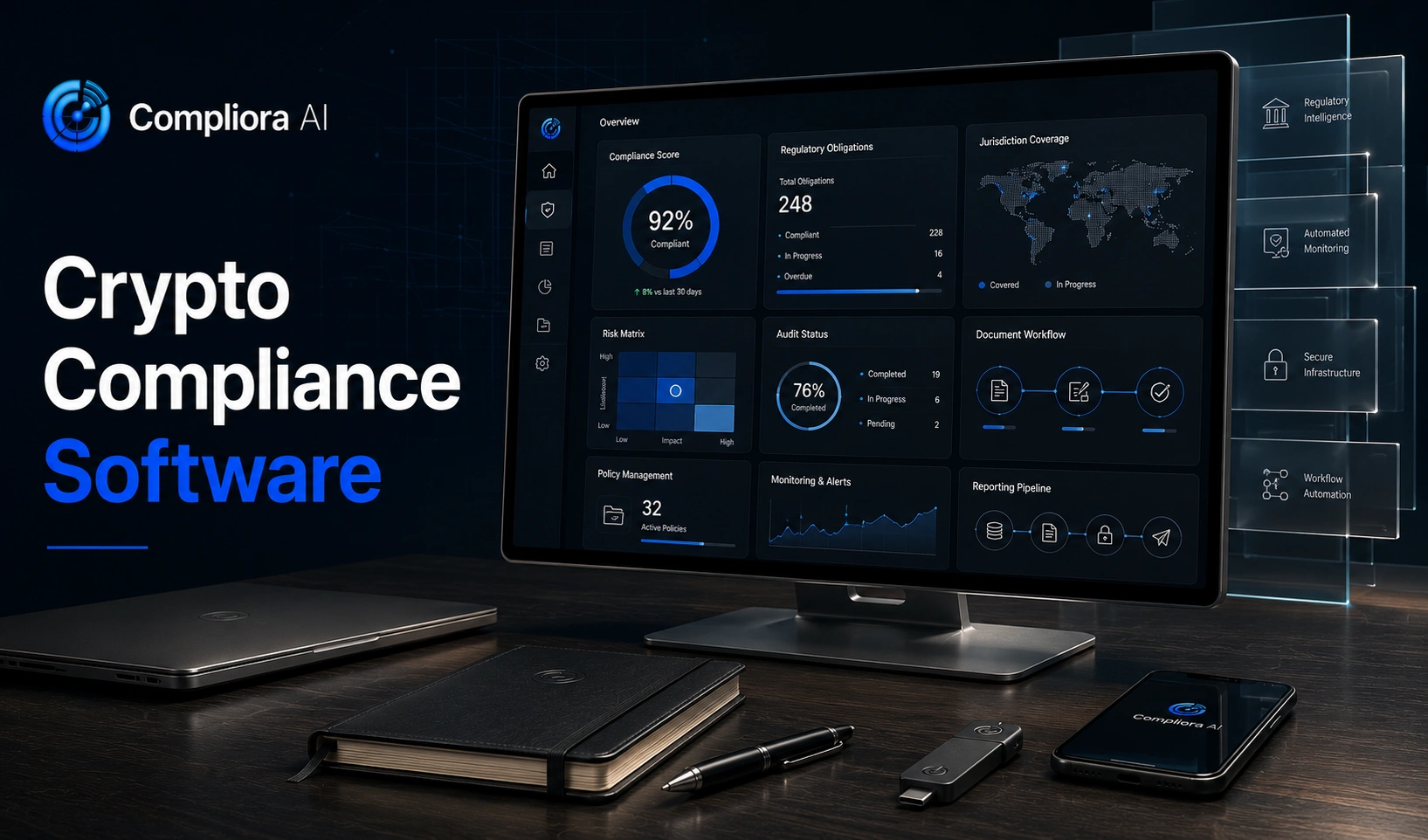
These are different problems with different buyers. A transaction-monitoring platform will not tell you whether you need a licence; a classification tool will not screen your customers. A pre-launch project almost always needs the first category first — you cannot monitor for a regime you have not confirmed you fall under. Compliora AI sits squarely in that first category: regulatory classification and the exact licensing path, with article-level citations.
Manual vs AI-assisted regulatory review
For the classification question, teams historically had one option — instruct EU regulatory counsel. That still produces the most defensible answer, but at a cost and speed that does not fit early-stage iteration. AI-assisted review has become a realistic complement for the first pass:
| Manual legal review | AI-assisted software | |
|---|---|---|
| Turnaround | 1–2 weeks | 10–15 minutes |
| Cost per question | €1,500+ | From €49 |
| Article-level citations | Yes | Yes — if built on the law texts |
| Consistency | Varies by reviewer | Same methodology every time |
| Edge cases & final sign-off | Strong | Flags them for counsel |
| Best for | Contested / novel structures, filing | Fast first assessment, iteration |
The honest framing is not “AI instead of lawyers.” It is: use AI-assisted software to get a fast, cited, structured first assessment — then spend counsel’s time, and your budget, only on the genuinely hard edges rather than on re-deriving which regulation applies from scratch.
What to look for in crypto compliance software
Most tools marketed as “AI compliance” are a general chatbot with a compliance prompt. For a regulatory decision, that is not enough. Look for:
- Grounded in the actual law texts. The analysis should cite specific articles — for example “MiCA Art. 59(1)” or “MiFID II Art. 4(1)(15)” — not paraphrase from training data. If it cannot cite, it cannot be checked.
- Coverage of every relevant framework. A single token can trigger MiCA, MiFID II and AIFMD at once. A tool that only “knows” MiCA will miss the security-token or fund overlaps. See our overview of how the EU frameworks interact.
- Adversarial verification. A second pass that argues against the first conclusion catches the confident-but-wrong classifications that single-pass tools produce.
- Plain-English, auditable output. A report your counsel can review and your NCA would recognise — ideally a PDF with citations — not a chat transcript.
- Honest limits. A serious tool tells you where it is uncertain and where you need a lawyer.
Where software ends and counsel begins
No crypto compliance software is legal advice, and any vendor claiming otherwise is a red flag. Software is preliminary screening: it narrows the question, surfaces the frameworks and citations, and indicates the likely licensing path — turning weeks of ambiguity into a structured starting point. Novel token structures, contested classifications, and the final authorisation file still need qualified EU regulatory counsel. The value of good software is that it makes that counsel cheaper and faster by handing them a cited draft instead of a blank page. For an ongoing obligation such as operational resilience, the same split applies — see our DORA compliance guide.
Frequently Asked Questions
What is crypto compliance software?
Crypto compliance software helps crypto and Web3 projects determine and meet their regulatory obligations in a given market. In the EU it spans regulatory classification and licensing (which of MiCA, MiFID II, PSD2 or AIFMD applies and what authorisation you need), AML/KYC and transaction monitoring, and regulatory reporting. These are separate categories — most early-stage teams need the classification-and-licensing category first.
Can crypto compliance software replace a lawyer?
No. Crypto compliance software produces preliminary, AI-assisted screening — not legal advice. It is best used to get a fast, cited first assessment of which rules apply and your likely licensing path, then to focus qualified EU regulatory counsel on the genuinely hard questions. It makes legal review cheaper and faster; it does not remove it.
Does crypto compliance software cover MiCA?
The good tools do — and more. Because a single crypto product can fall under MiCA, MiFID II and AIFMD simultaneously, effective software assesses all the relevant EU frameworks together, not MiCA in isolation. Compliora AI assesses MiCA, MiFID II, PSD2 and AIFMD applicability with article-level citations.
How much does crypto compliance software cost?
Pricing ranges from usage-based reports to enterprise subscriptions. A full EU regulatory assessment from counsel typically costs €1,500 or more per question; AI-assisted assessment tools are far cheaper — Compliora AI produces a cited, plain-English report from €49, with a free preview and no signup.
Is AI accurate enough for EU regulatory analysis?
It depends entirely on how the tool is built. A general chatbot with a compliance prompt is not reliable for a regulatory decision. AI that is grounded in the actual regulation texts, cites specific articles, and stress-tests each conclusion with an adversarial review step is accurate enough for a defensible first pass — provided its output is reviewed by counsel before you rely on it.
Check which EU rules apply to your project. Compliora AI runs a five-agent, adversarial assessment across MiCA, MiFID II, PSD2 and AIFMD and returns a plain-English report with article-level citations in 10–15 minutes. Start a free assessment →